What You Need to Know about Taking Culture from Paper to Practice

What We Get Wrong About Fairness in the Workplace
For far too long, organizations have treated fairness as a complicated and subjective concept.
One person considers a decision fair. Another person disagrees. Leaders conclude that fairness is too difficult to define, measure, or manage.
But research suggests that fairness is far less ambiguous than we often assume.
Even young children demonstrate a sophisticated understanding of fairness. In one study, four- and five-year-old children were asked to distribute an odd number of marshmallows between classmates who had completed the same amount of work. Rather than reward one child more arbitrarily, they discarded the extra marshmallow so both classmates received equal rewards for equal work.
The basic principle was clear to them.
The challenge in organizations is not that people cannot recognize fairness. It is that too many workplaces declare fairness in policies and values without following through in everyday practice.
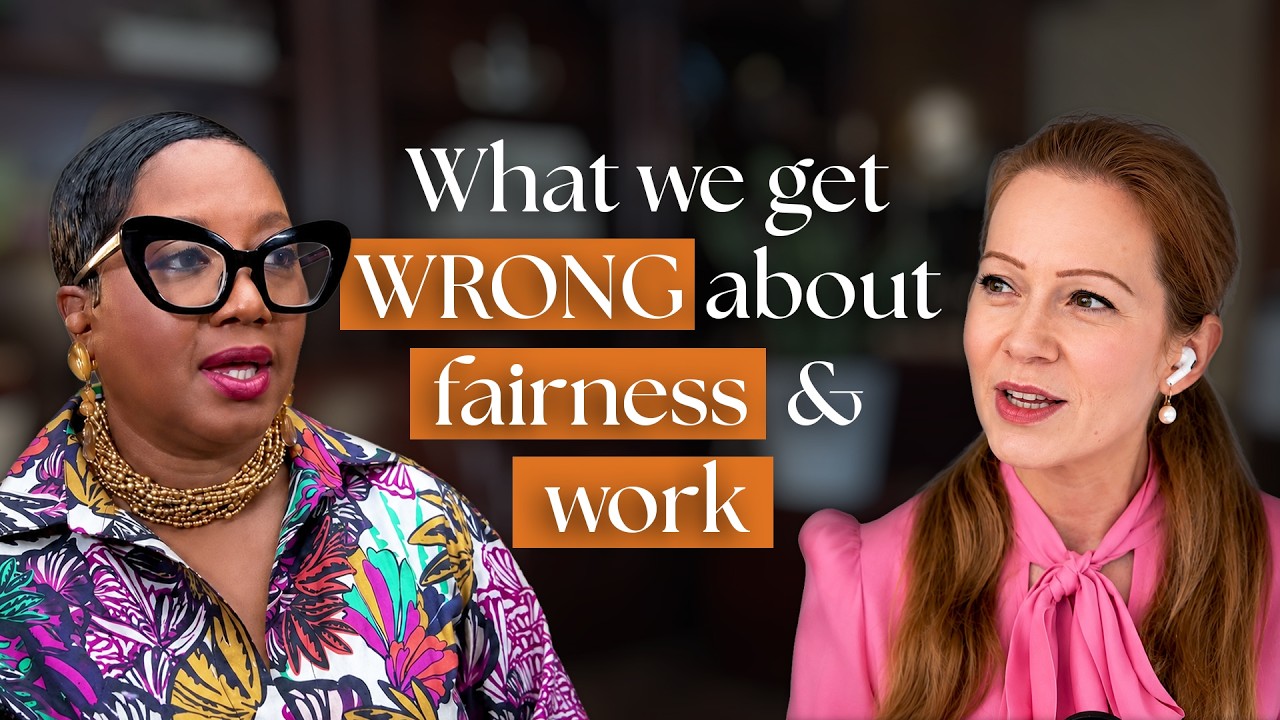
In this episode of The SHIFT Forward, Dr. Cindy Pace speaks with Siri Chilazi, a senior researcher with the Women and Public Policy Program at Harvard Kennedy School and an internationally recognized expert on advancing women and gender equity in organizations.
Siri is also co-author, with Iris Bohnet, of the award-winning book Make Work Fair: Data-Driven Design for Real Results.
Together, they explore how leaders can move fairness from company policies and aspirational language into measurable outcomes. Their conversation examines culture as a living system of norms, rituals, relationships, and power that determines how people actually experience work.
Fairness Is a Universal Human Value
Fairness is one of the most widely shared human values across cultures.
People understand that different levels of effort, contribution, or performance can produce different outcomes. They do not necessarily expect every employee to receive the same compensation, promotion, assignment, or recognition.
What people expect is a fair process.
They want to know:
Were people evaluated using the same relevant criteria?
Did everyone receive meaningful consideration?
Were expectations communicated clearly?
Did some candidates have access to a hidden route?
Were decisions affected by favoritism or relationships?
Did everyone receive the resources needed to compete?
Can the organization explain how it reached the decision?
People can accept an outcome that does not favor them when they believe the process was consistent, transparent, and legitimate.
That distinction is essential. Fairness does not always mean equal outcomes. It means people receive equitable opportunities, appropriate support, and consistent consideration.
The 100-Meter Race: A Model for Workplace Fairness
Imagine the 100-meter final at the Olympics.
Every runner begins at the same starting line and finishes 100 meters later. They compete on the same track under the same conditions, following the same rules. Because the race is structured consistently, the athlete who crosses the finish line first can reasonably be identified as the fastest runner in that race.
Now change the conditions.
Ask some athletes to remove their specialized running shoes. Move others from the performance track onto grass. Place another group’s starting line 20 meters behind everyone else, forcing them to run 120 meters instead of 100.
No reasonable observer would call that a fair race.
The athletes would not be competing under the same conditions. A slower finish would no longer provide reliable evidence of lower ability. The result would be influenced by the track, distance, equipment, and support each runner received.
Workplaces frequently make the equivalent mistake.
Organizations compare employees’ outcomes without examining whether those employees received comparable opportunities, resources, sponsorship, visibility, training, feedback, and access to decision-makers.
The problem may begin even earlier.
Some athletes have access to world-class coaches, customized equipment, sports medicine, advanced facilities, nutrition, and technology. Others may grow up hundreds of miles from the nearest track.
Organizations cannot correct every inequity someone experienced before joining the company. But that does not excuse them from addressing the conditions they control.
Every institution must take responsibility for its part of the race.
What Employers Can Control
An organization may not be able to correct every social, educational, or economic disparity. It can still examine the fairness of its own systems.
That includes:
Talent attraction
Recruiting
Candidate screening
Hiring
Onboarding
Work allocation
Performance evaluation
Compensation
Recognition
Promotion
Professional development
Succession planning
Layoff and termination decisions
Leaders should ask whether each stage gives employees a meaningful opportunity to demonstrate what they can do.
A great workplace cannot promise that everyone will reach the same destination. It can promise to remove unnecessary barriers, make expectations clear, and give people the support and opportunity to succeed.
Promotable and Non-Promotable Work
One of the most consequential forms of workplace unfairness involves how assignments are distributed.
Promotable work increases an employee’s visibility, strengthens valuable skills, connects them with influential leaders, and demonstrates readiness for advancement. Examples might include leading a major client relationship, presenting to executives, managing a strategic initiative, or developing a new product.
Non-promotable work is necessary but rarely rewarded with advancement. Examples can include:
Scheduling meetings
Taking notes
Organizing celebrations
Making copies
Coordinating office logistics
Managing routine administrative work
Running programs that receive little executive attention
Performing behind-the-scenes support work
These tasks may be valuable and essential. The problem arises when the same employees repeatedly receive them while others consistently receive high-visibility assignments.
An employee cannot demonstrate readiness for promotion without access to work that allows them to display the necessary skills.
Organizations should track both promotable and non-promotable assignments. Necessary support work should be recognized and distributed fairly rather than quietly assigned to the people most likely to say yes.
Before comparing employees’ performance, leaders must determine whether they were actually given comparable opportunities to perform.
Agency Is Part of Fairness
Fairness also affects how much agency people experience in their work.
Employees want the ability to ask questions, request clarity, and challenge decisions without fearing retaliation. Once goals and expectations have been agreed upon, they often want appropriate freedom to determine how they will accomplish the work.
That autonomy allows people to bring more of their strengths, creativity, meaning, and purpose into a role.
A people leader therefore does more than assign tasks. The leader continuously negotiates expectations, resources, decision rights, and methods with the team.
This requires listening.
Leaders cannot determine what fairness means within a team solely from their own perspective. They need a continuing conversation about what people need, how decisions are experienced, and where inconsistencies exist.
Why Transparent Processes Matter
Research on procedural fairness consistently finds that people are more willing to accept unequal outcomes when they trust the process used to reach them.
Most employees understand that not everyone will become CEO, receive the same salary, or earn every promotion. They know that experience, performance, responsibility, and capability can justify differences.
What damages trust is the suspicion that people were not evaluated consistently.
Employees want to know:
What criteria were used?
Were those criteria established before the decision?
Did the criteria change for a favored person?
Did everyone have access to the same information?
Were all candidates genuinely considered?
Who participated in the decision?
Was employee input invited?
Can the organization explain the result?
Transparency does not require leaders to disclose every confidential detail. It does require them to explain how important decisions are made.
Leaders can build trust by communicating the processes behind performance evaluation, compensation, work allocation, promotion, and development opportunities.
Speak Less and Listen More
A study conducted at the global pharmaceutical company Novartis examined how managers could increase psychological safety and belonging through their regular one-on-one meetings.
The most effective guideline was simple: Managers should speak less and listen more.
Instead of controlling the agenda, managers gave direct reports greater ownership of the conversation. They asked questions such as:
What is happening in your work?
What is going well?
What challenges are you encountering?
What roadblocks can I help remove?
Where do you need greater clarity?
How can I help you focus on the work with the greatest impact?
This approach provides employees with voice and agency.
A one-on-one meeting should not merely be a status report delivered to a manager. It can be a forum where employees shape the support they receive and participate in decisions about how the work gets done.
Psychological safety and belonging become more concrete when leaders connect them to observable behaviors.
Listening is one of those behaviors.
Policies on Paper Versus Policies in Practice
Policies matter, but a policy’s existence does not prove that people experience fairness.
There is always a difference between the written policy and the policy in practice.
An organization may have a detailed performance-management process. But if criteria are applied differently depending on the employee, the written policy offers little protection.
A company may say it values candid debate. But if people are punished for challenging a senior leader, employees learn that debate is not genuinely welcome.
An organization may publish a commitment to collaboration. But if employees compete for individual credit and hoard opportunities, the actual culture rewards competition.
People respond to what the organization repeatedly does—not what it says it believes.
This is why procedural fairness requires more than distributing criteria. Employees should have opportunities to understand, question, and sometimes help shape the process.
Leaders must continually examine whether established policies still serve the organization and whether employees experience them as intended.
Every Organization Has an Unspoken Hierarchy
Ask employees whose work is considered most important, and they will usually have an answer.
They observe:
Whose emails receive immediate replies
Who waits days for a response
Who receives access to senior leaders
Who is invited into important meetings
Whose ideas are credited
Who receives high-profile assignments
Who is allowed to challenge leadership
Whose mistakes are forgiven
Who receives informal coaching and sponsorship
Who is expected to perform support work
Employees can identify the hierarchy without access to compensation records or formal organizational charts.
They learn it by watching behavior.
These observations reveal the organization’s actual values and power structure. When leaders evaluate workplace fairness, they must pay attention to these small, repeated behaviors—not only large policies and public commitments.
Culture Is “How We Do Things Around Here”
New employees receive handbooks explaining benefits, leave policies, workplace rules, and administrative procedures.
Those documents rarely explain what someone truly needs to know to succeed.
They do not necessarily answer questions such as:
Do meetings begin exactly on time?
Is multitasking during meetings acceptable?
Can a junior employee challenge a senior leader?
Should disagreement happen publicly or privately?
How does someone join a desirable project?
Is it acceptable to contact a senior executive directly?
What does someone actually need to do to get promoted?
Who receives sponsorship?
How quickly are employees expected to answer messages?
Employees discover these rules by observation.
Within their first weeks, they learn which behaviors receive approval and which generate discomfort or punishment. These shared but often unspoken expectations are social norms.
They are also the building blocks of culture.
Culture is often discussed from 30,000 feet: “Our culture is strong,” “Our culture needs to change,” or “We have a collaborative culture.”
Greater progress becomes possible when leaders move to ground level and identify the specific behaviors people demonstrate every day.
Culture is not an abstract atmosphere. It is “how we do things around here.”
The Damage Caused by Hidden Cultural Codes
A company may recruit someone by praising their creativity, innovative thinking, technological fluency, and willingness to challenge existing practices.
The new employee arrives believing those qualities are wanted.
During an early meeting, the leader asks for feedback. The employee enthusiastically offers a critical perspective. Suddenly, the leader’s expression changes. Colleagues become uncomfortable.
The employee learns that the invitation to speak was not genuine.
They may receive a subtle correction after the meeting, a figurative tap on the shoulder explaining that “this isn’t how we do things here.”
One correction may feel minor. Repeated corrections become cuts by a thousand.
As employees struggle to interpret unwritten cultural codes, their confidence, identity, and sense of belonging can erode.
The unfairness becomes especially clear when some people are allowed to challenge authority, show emotion, or break norms while others are punished for the same behavior.
Employees notice those differences, and trust deteriorates.
Do Not Recruit Disruptors Without Telling Them the Truth
Organizations frequently hire people to transform a team or repair an underperforming function without being honest about the resistance they will face.
A fairer approach begins during recruitment.
A hiring leader might say:
“We are hiring you because this part of the organization needs to change. We value your innovative thinking and your ability to lead a turnaround. We also need to be honest: Some employees are deeply attached to the current way of working, and they may resist you.”
That transparency gives the candidate an informed choice.
If the person accepts the role, they enter with a clearer understanding of the terrain. Leaders can then provide the challenge and support necessary for success.
That support should continue beyond a 90- or 100-day onboarding period. Leaders should offer regular feedback about what is working, what needs to be adjusted, and how the organization typically responds to change.
They should also ask:
What resistance are you experiencing?
What cultural dynamics are you noticing?
Where do you need my support?
What should we address together?
What are you learning about how this organization changes?
The same approach applies when current employees take on unfamiliar work. Whenever leaders introduce ambiguity or disruption, they should address how people will navigate it.
Fairness Requires Transparency and Co-Creation
Leaders can begin making work fair by sharing information that has historically remained hidden.
Ask team members:
What do you wish you understood about this organization?
What information would give you greater clarity?
What questions do you have about your career trajectory?
What would help you understand how decisions are made?
What do some employees appear to know that others do not?
Where do you experience inconsistency?
This remains important during uncertainty.
Leaders may not know exactly how AI, restructuring, or economic conditions will affect the team. They can still be honest about what they know, what they do not know, and what remains outside their control.
Pretending to have certainty will deepen mistrust when the truth emerges.
A leader might say:
“I don’t know whether our team will exist in its current form six months from now because those decisions will be made elsewhere. Here is what I know today, here is what we can influence, and here is where our effort can be most useful.”
That honesty makes room for co-creation.
No leader has all the answers in a rapidly changing environment. The people closest to the work often possess the strongest information about what succeeds, what fails, and what needs to change.
Inviting those employees to shape the path forward increases fairness, strengthens commitment, and often produces better results.
Fairness and Culture Are Measurable
Fairness is not too fuzzy to measure. Neither is culture.
Organizations already possess data that can reveal how people experience work.
For example, leaders can examine:
How speaking time is distributed in meetings
Who receives high-visibility assignments
Who performs non-promotable work
Who receives credit for deals and ideas
Who shares credit with colleagues
Which teams communicate across organizational boundaries
Who receives quick responses from senior leaders
Who receives mentorship or sponsorship
How performance ratings compare across demographic groups
Whether compensation gaps remain after accounting for relevant factors
Who is hired, promoted, retained, or terminated
Who has access to learning and development
How long employees wait for advancement
Who reports psychological safety and belonging
Organizations do not always need to invent new data-collection systems. Much of the information already exists in operational systems, meeting records, talent processes, employee surveys, and workflow tools.
The opportunity is to analyze those data, identify patterns, discuss them openly, and decide what should change.
Data should not create analysis paralysis. It should help leaders ask better questions and take more focused action.
Culture Is a Living System
Culture is a mega shift because the old way of thinking about it no longer supports future-ready workplaces.
Culture cannot be reduced to what appears on walls, what an organization celebrates, or the awards it receives.
It is a living system made up of:
Norms
Rituals
Relationships
Behaviors
Decisions
Incentives
Access
Status
Power
Together, those elements determine how people experience work.
A purpose-driven, high-trust, high-performing culture must be intentional, understood, shared, and measurable.
Culture also exists wherever two or more people interact. Leaders do not need to wait for a company-wide transformation. They can begin with the culture of their own team.
What Organizations Miss About Fair Systems
Fairness requires examining the entire system—not merely the final result.
In a race, fairness depends on far more than the starting line and finish line. It includes training, coaching, facilities, equipment, medical support, nutrition, and access to opportunities.
The same principle applies at work.
Leaders must examine what happens before an employee is evaluated:
Did the employee receive a meaningful assignment?
Were expectations clear?
Did they have adequate resources?
Did anyone provide useful feedback?
Did they receive the same access to decision-makers?
Were they given time to develop?
Did someone advocate for them?
Were they asked to perform disproportionate support work?
Did workplace norms allow them to contribute fully?
Fairness is not achieved by applying the same final test to people who were given profoundly different conditions in which to prepare.
A fair system seeks to ensure that everyone receives what they need to compete and contribute successfully.
How Long Does Culture Change Take?
Culture is always changing.
It can shift when an organization introduces a new strategy, appoints a new leader, launches a major project, reorganizes teams, or adopts new technology.
The timing of cultural change is therefore situational.
But some foundational principles should remain consistent:
How people are treated
How people are valued
Whether expectations are clear
Whether employees can speak honestly
Whether leaders follow through
Whether decision-making is transparent
Whether people have equitable opportunities
Whether the organization measures employee experience
Leaders should begin by understanding the culture where they currently sit.
What does the team reward? What does it discourage? Who has influence? Who gets heard? Which behaviors are tolerated? How are decisions made?
Culture becomes easier to change when leaders stop treating it as an enormous, abstract corporate concept and begin examining the observable behavior of their own teams.
The Shift Forward
Fairness in the workplace does not require identical outcomes. It requires fair opportunities, transparent processes, consistent criteria, employee voice, and accountability for the systems an organization controls.
People will tell you what the culture values: not only through surveys, but through what they experience every day.
The leader’s responsibility is to listen, examine the data, make hidden processes more visible, and close the gap between policy and practice.
Fairness is not fuzzy.
It is built through specific decisions, repeated behaviors, and measurable outcomes. When leaders take responsibility for those elements, they can create workplaces where more people have a genuine opportunity to succeed.
Add Your Heading Text Here
Lorem ipsum dolor sit amet, consectetur adipiscing elit. Ut elit tellus, luctus nec ullamcorper mattis, pulvinar dapibus leo.