The #1 Leadership Mistake That Breaks Trust (and How to Avoid it)

Rethinking Leadership, AI, and Our Best Work
Expecting trust to take care of itself is a catastrophic error. Many organizational transformations treat trust as an afterthought. But if you are not intentionally building and nurturing trust, it is already eroding and negatively affecting your workplace culture.
A 2025 Gallup survey found that only 19% of employees strongly trust the leadership of their organization, down from 24% in 2019.
Have we oversimplified trust?
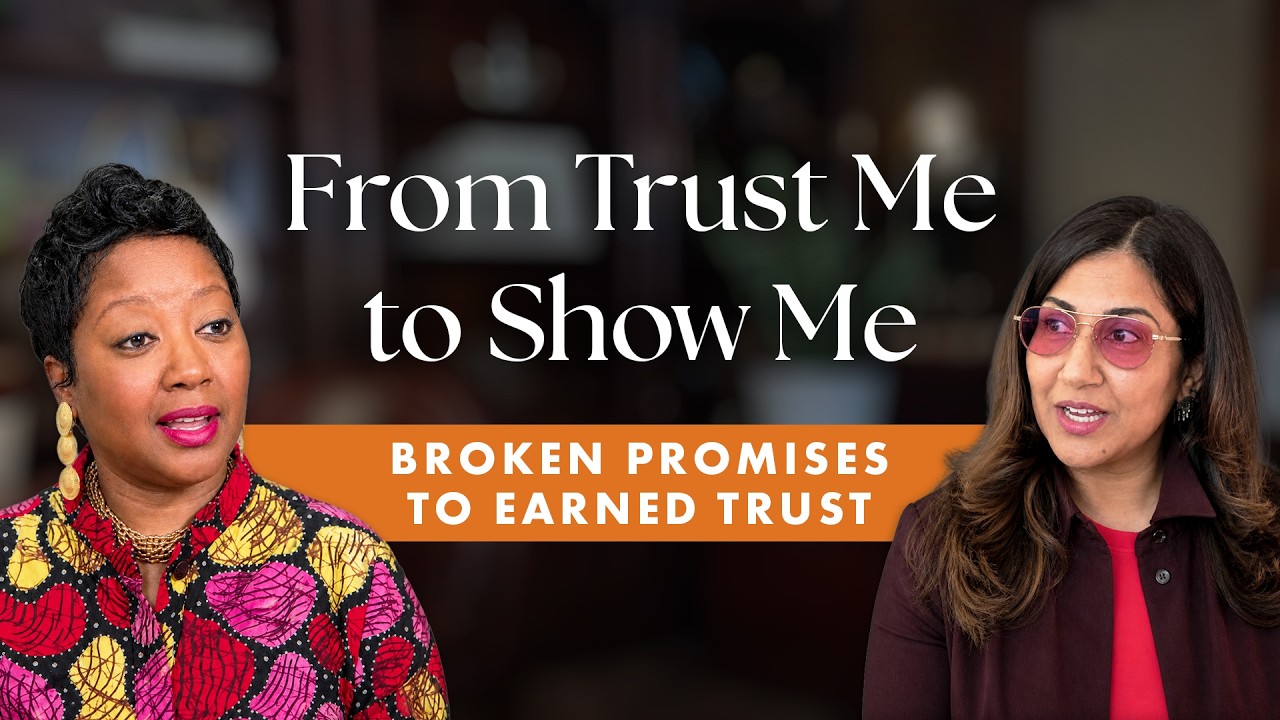
Trust appears in company values, is proclaimed during town halls, and is written into memos as an organizational promise. But words are no longer enough. We cannot assume trust will simply emerge from what we say rather than what we do. In this episode of The SHIFT Forward, Dr. Cindy Pace speaks with Nilofer Merchant, one of the world’s leading management thinkers, CEO of Intangible Labs, speaker, and author of Our Best Work. After more than 25 years of leading and advising technology companies including Apple and Adobe, Nilofer understands how trust is built, how it breaks, and what leaders must do to earn it. Together, they explore trust as a dynamic, personal, habitual, and deeply relational practice.
Why Trust Made the Cut
Cindy: It’s a pleasure to have you. It was wonderful seeing you last year in London at Thinkers50, and congratulations on being ranked one of the top management thinkers of our time.
Nilofer Merchant: Thank you. Ten years running now. It’s amazing.
Cindy: Today, I want to talk about trust.
I’ve identified trust as one of the mega shifts affecting our workplaces. Mega shifts aren’t predictions or exercises in strategic foresight. They are behaviors and forces already at work. If we keep doing what we’ve always done, we won’t be able to build the so-called future-ready workplace.
In Our Best Work: Breaking Free from 24 Invisible Norms, what was it about trust that made the cut?
Nilofer: I’m often told by people I work with, “Trust me.”
My first instinct is usually to affirm them and say, “Of course I trust you.” But when that happens, I’m not necessarily deciding what I’m trusting that person to do.
We instinctively say yes because we want to remain in a relationship with the person. Work is so much about relationships. But we don’t always pause and ask, “What decision am I actually making?”
I might trust someone in one area and then allow that trust to expand into another area where the person hasn’t demonstrated the necessary capabilities. I may be granting more access or authority than that person has earned.
Trusting Leadership During the AI Revolution
Nilofer: Consider what we’re seeing across the technology industry.
Jack Dorsey announced that Block would reduce its workforce by approximately 40% as the company adopted AI to improve productivity. He also said it wasn’t a cost-cutting exercise because the company was profitable.
Something about that didn’t make sense to me.
I asked myself: If I could improve my company’s performance by 40% or 50% using these tools, wouldn’t I keep the talented people I had already hired and use those tools to drive 40% growth?
The announcement didn’t pass my basic litmus test.
That isn’t a judgment about whether Jack is a great technologist. I was examining the specific claim he was asking us to accept: that AI can replace humans and improve the company’s performance.
We often think, “He’s a great technology leader, so I should trust his next assertion.” We need to ask whether making that leap without a more considered process is truly serving us.
Cindy: That’s an excellent example of the importance of transparency.
In the quest for greater profitability, productivity, and innovation, organizations embraced AI as the answer. What was often left out of the conversation was the disruption AI would create in existing workflows and in people’s lives.
Employees are looking around and seeing attrition and enormous change, whether it’s happening in their company or elsewhere. What they aren’t hearing is how AI will help them. That absence of transparency creates a lack of trust.
In your book, you write that trust is not a feeling we summon or a promise we make. Yet that’s how we commonly talk about it. We say, “I don’t feel like I can trust you,” or, “Trust me, I’ve got you.”
How should leaders rethink trust and the way they communicate during change?
Secrecy Erodes Trust
Nilofer: Let’s continue using Block as a case study.
Although the announcement wasn’t framed as being about people, I learned that some remaining employees were offered significant increases in compensation. Each person was essentially told, “You’re special. We want to make sure you stay with us during this transition, so we’re increasing your pay while we let your colleagues go.”
Some of the employees I spoke with felt survivor’s guilt. The compensation decisions weren’t being openly discussed.
Whenever someone tries to conceal information that materially affects people, I become suspicious. Most people do. If I discover something you were actively trying to prevent me from learning, I’m going to trust you less.
This is one reason trust has been eroding across institutions. Institutions often attempt to hide the very thing they don’t want people to know. Because we now have unprecedented access to information, people eventually uncover it and gain another reason not to trust the institution.
There was also an important absence of information: no one said, “We tested this.”
The conversation happening across companies is often reduced to a binary question: Should we use AI, or shouldn’t we?
Binary thinking is a clue that something is off. AI is an extraordinarily complicated issue. Complex problems rarely have only two possible answers.
The question isn’t whether to use AI. Better questions include:
In what ways can AI help us carry out our strategy?
How can AI enable our people to feel more alive at work?
Where does AI make sense for this organization, its workforce, and its goals?
Those are nuanced questions. The answers will be specific to each organization, its people strategy, and its business strategy.
Complexity requires complexity in return. When I hear binary answers to complex problems, I suspect we are oversimplifying something that requires deeper examination.
Have We Oversimplified Trust?
Cindy: Gallup recently examined the qualities people seek from leaders and why people choose to follow them. Trust was one of the central qualities.
Two dimensions of trust stood out to me: transparency and integrity. As you’ve said, trust isn’t binary. How do we move toward a more earned form of trust?
Nilofer: In the book, I share the story of a dear friend who accepted a chief-of-staff position.
She was an exceptionally smart strategist who had worked at major companies, operated her own firm, and completed years of due diligence on the organization. It had an outstanding reputation for treating people well.
But when she joined, she began noticing problems. Even though the team was small, the onboarding process was miserable. She thought, “They may simply be too small to have designed this well. I can fix it so the next employee has a better experience.”
Instead, she was told that she was overreaching and stepping on people’s toes.
The organization had promised one experience, failed to deliver it, and then pushed back when she tried to improve it. Yet she continued telling me, “This is my dream job.”
I wanted to tell her that if the organization wouldn’t allow her to contribute value, it wasn’t her dream job by definition.
Later, my 22-year-old son read the chapter and told me that he would never automatically trust a company based on what it said. His generation has watched parents make tremendous sacrifices for organizations, only to be walked out the door.
That response might be cynicism, skepticism, or simply realism.
Research suggests that when we’re deciding whether to trust someone, we aren’t only trusting them, we’re trusting ourselves.
My friend had spent years researching the organization and forming an evidence-based opinion. Once she arrived, she wanted that opinion to remain true. She believed she was smart, had done her due diligence, and had made the right decision. When reality contradicted that belief, she tried to resolve the dissonance by making the organization fit her expectations.
Instead, she needed to ask: “Now that I’m here, what do I know that I didn’t know before?”
That opportunity to think and rethink is missing from many trust models.
We say, “I trust this person,” or, “I don’t trust institutions.” Those are binary positions. We need to become more specific and present.
If a leader tells me that change is coming and promises to keep me informed, the relevant question might be: “Can I trust this leader to share as much as she knows?”
She may not have all the information. Recognizing that creates a more realistic foundation. We can set expectations together and decide where to go from there.
Trust Is a Relational Construct
Cindy: Research from NYU examined why we continue trusting despite contradictory evidence.
Whom we trust reflects not only who is trustworthy, but also who we believe ourselves to be. We want to believe that we made the right decision and chose wisely. We tell ourselves to trust the process, wait for improvement, or try another approach.
How do our brains play tricks on us when it comes to trust?
Nilofer: We often think trust is tied solely to the other person: “Do I trust Cindy?” That frames trust as being entirely about Cindy.
But trust is a relational construct. It is as much about me as it is about you.
Suppose your position is that you will share as much information as you know. My position might be that without enough information about the company’s direction, my career could be at risk. I may need to put some eggs in other baskets because I’m responsible for my own career longevity.
Both positions are valid.
Recognizing that allows us to explore the interaction between them. I might say, “I hear that you’ll share as much as you know, but I also know I can’t wait six months to discover how this situation plays out.”
Now we can have a more adult conversation. I’m not waiting passively for you to decide my future, and I’m not automatically running away. We’re asking, “What do we know now?”
People often assume that because they have a history with a team or because others know the quality of their work, they will automatically be promoted. Then they discover that the situation is far more complex.
Similarly, people may trust someone to advocate for them, only to discover that the person misrepresented their interests.
Trust always contains complexity.
What Honest Leadership Sounds Like
Cindy: AI adoption is one of the largest disruptions affecting organizations today.
How can a people leader find the courage and vulnerability to say:
“I don’t know what will happen, and I can’t promise that your job will remain exactly as it is. What I can promise is that I’ll share what I know. I also want to ensure that this team develops the skills to pursue the work you want—whether that work is here or somewhere else.”
Some leaders may be terrified to say that. But at some point, people need to understand that there is no completely safe space.
Nilofer: People already know that. They’re waiting for the leader to acknowledge it.
Younger generations, in particular, know their jobs aren’t guaranteed. If leaders refuse to say what employees already understand, they aren’t participating in the same conversation.
If trust is relational, it isn’t a private act. It’s about how we come together. Each person must take responsibility for identifying what they want, need, and believe.
Cindy: I’ve been thinking of trust as a social contract. It is highly relational, and we have agency within it.
Trust hasn’t always been presented that way. It is often described as something that happens to us. But trust is co-created, and there is a relationship between trust and truth.
How do we move beyond limiting beliefs and behaviors and exercise greater agency?
Refusing to Participate in Your Own Oppression
Nilofer: A friend of mine recently participated in a university search for a new dean. The provost presented the committee with two candidates.
One was clearly unqualified. The second had serious unanswered questions.
I asked, “Can you reject both and request a better search?”
She believed the process had been designed to force the committee to select the second candidate.
I told her that the provost was entitled to advance their agenda. That is part of the provost’s role. But her role was to advocate for what the school needed.
If she simply acquiesced, she would be participating in her own oppression.
At minimum, she could say:
“I don’t endorse this process or this candidate. Selecting the better of two inadequate options would be a disservice to the school. Our candidate pool was not strong enough to support a good decision, only a default decision.”
Even if that candidate received the position, the person would enter the role from a compromised place. Everyone involved would know that the candidate hadn’t earned genuine support. The person could be set up for failure before even beginning.
Other people can still make their own choices, but we must clearly state what we know to be true.
Saying that we are participating in our own oppression may sound harsh, but it can also be kind. If we say, “I have no choice and no power because they’re going to do what they want,” we’re saying that only their vote counts.
Trust is relational, so my vote counts too. I can step back and say, “I don’t agree, and here is my perspective.”
Dissenting opinions matter. When the Supreme Court issues a ruling, dissenting opinions often influence the next generation of constitutional law. The dissent articulates what was missed and can become part of the architecture for what comes next.
Organizations also need people willing to say, “I dissent, and here’s why this decision could harm us.”
If I allow an unsupported candidate to move forward without clearly identifying the risks, I have abdicated my responsibility within that relationship.
Cindy: Trust then begins breaking down throughout the system. Others may lose trust in you because you saw something important but failed to call it out.
Nilofer: Exactly.
Trust can fail in two directions. It fails when I automatically trust someone based on past performance or because they ask me to trust them. It also fails when I refuse to give voice to what I know to be true when I don’t trust my own experience.
Learning to Trust Yourself
Cindy: Our relationship with change is becoming increasingly important.
Change is happening around us every day. Some changes are small; others are enormous. Many people feel unsettled and say, “This isn’t what I signed up for.”
I ask them, “Is work serving you in the way you want it to?”
The employment contract has fundamentally shifted. If you’re waiting for work to feel the way it did last year, that isn’t going to happen.
We need to be honest with ourselves and ask:
Is this the best and highest use of my skills?
Do I currently possess the capabilities required to deliver?
If not, how will I strengthen them?
How can I invest in myself instead of waiting for an organization that may or may not make that investment?
That begins with our relationship with trust.
Nilofer: If we can teach ourselves to trust ourselves, then when someone gives us a false account of reality, we can say, “That isn’t my experience.”
Our lived experience is credible, regardless of our position on the team. It gets to count.
The Hidden Trust Problem Behind AI Adoption
Cindy: Organizations sometimes believe they understand their employees’ experiences when there is actually a huge disconnect.
At one organization, leaders believed employees were universally excited about the AI tools being introduced. Some people genuinely were excited. But employees were also using AI tools privately and avoiding disclosing that use.
Through individual conversations, I learned that some employees feared they wouldn’t be perceived as capable or intelligent if they admitted using Copilot, Claude, or another AI tool. Others worried that admitting they used AI would make them appear replaceable.
Leadership thought, “Look how well we’re doing. Everyone loves these tools.”
But there was a serious lack of trust surrounding how employees used them.
Nilofer: If people believe a tool could eliminate their job, income, and ability to survive, why would they voluntarily participate in implementing it?
I’ve been considering a different possibility.
Human beings are distinctly capable of creating insight and intelligence. AI gives us an opportunity to distinguish jobs from work.
A job consists of tasks that can be scoped and defined. Work is how the self meets the world.
Today, much of what we call work is really a collection of repeatable tasks requiring little creativity. AI could become part of a revolution that moves us from jobs toward more meaningful work.
Cindy: I love that. AI could become a tool that helps us do what we aspire to do.
Nilofer: To use your language, it is the ultimate mega shift.
Imagine if work became more than a way to earn a paycheck. It could become how we actualize more of who we are and contribute our unique value to the world.
The joy inherent in that possibility is also connected to economic growth.
Conversations Shift Perspectives
Cindy: This has been such a rich conversation.
The reason we’re having this podcast, and having it in this way, is because I believe conversations shift perspectives.
Research from Edelman suggests that we’ve become more insular. We increasingly want to speak only with people who reaffirm our existing beliefs.
That isn’t how we grow, and it isn’t how we do our best work.
Our best work comes from opening ourselves to different ideas, experiences, ways of being, and ways of knowing. It comes from becoming willing to learn in new ways.
That happens through conversation.
I would love to have you return so we can continue discussing how to build the best workplaces: places where people can genuinely do their best work.
Nilofer: I’d love to, Cindy. I’m always game for doing things with you. Let’s do it.
Why Trust Is a Mega Shift
We can’t build our best workplaces without trust.
A mega shift occurs at both the organizational and societal levels. The mega shifts I’m examining are fundamentally affecting the future of work.
Unlike trends, mega shifts represent fundamental changes in behavior and mindset. They mean that whatever we’re currently doing will no longer work.
This isn’t a “fake it until you make it” situation. A mega shift requires us to stop repeating what we once did, learn something new, and apply it. It requires change.
Trust is a mega shift because trust is always changing.
For nearly a decade, much of my work has focused on organizational culture. At the heart of every great culture are trustworthy leaders. People need to believe they can trust the person they work for and the organization where they work.
The way we built trust even six months ago may not work today. Trust is dynamic, and anything changing rapidly amid disruption qualifies as a mega shift.
Trust doesn’t take care of itself. Trust is built.
Many of us entered the workplace during a time when employees simply trusted what leaders said and did what they were told. We’re in a different environment now. Four generations are working alongside one another, and each may understand and co-create trust differently.
Growth requires us to shift our perspective. That happens when we become more trusting and more open to different ideas, attitudes, and experiences.
That is why trust must be identified as one of the leading mega shifts of our time.
How are you leading change? What questions do you have about the future of work?
Leave a comment and join the conversation. Together, we’ll navigate the mega shifts reshaping our world and help you become the future-agile leader people need right now.
To stay ahead, subscribe to, like, and share The SHIFT Forward.
Add Your Heading Text Here
Lorem ipsum dolor sit amet, consectetur adipiscing elit. Ut elit tellus, luctus nec ullamcorper mattis, pulvinar dapibus leo.